
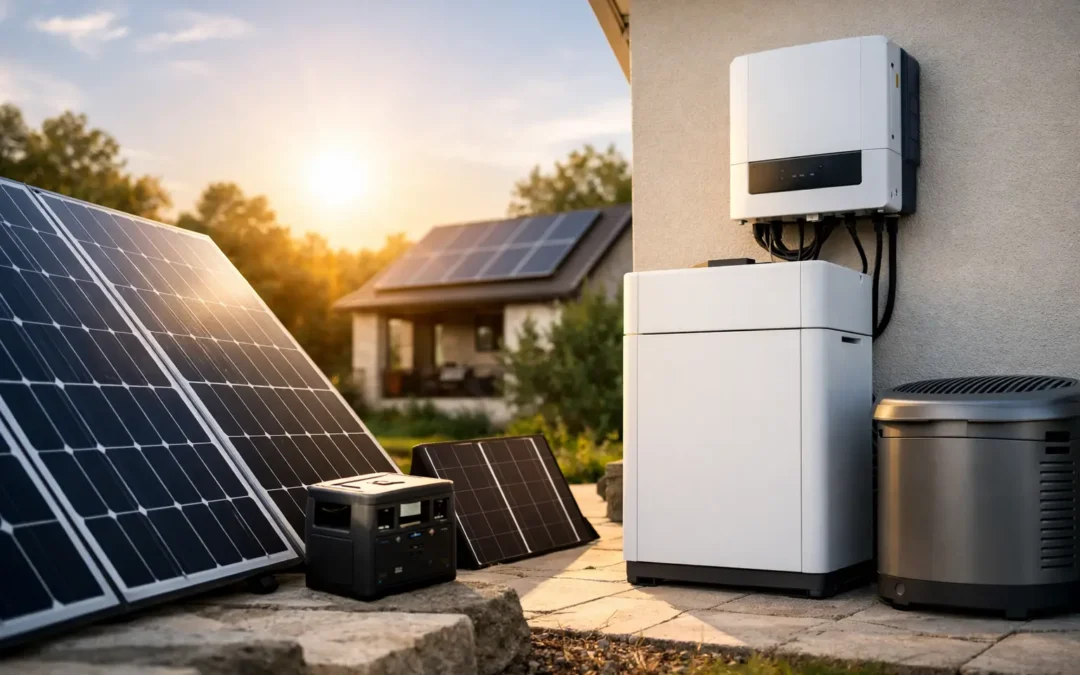
Power outages stop being abstract the moment your freezer warms up, your well pump cuts off, or your business loses a day of operations. That is why more property owners are comparing solar backup power options before the next storm, grid failure, or utility shutoff forces the decision.
Not every backup setup solves the same problem. A homeowner may only want to keep the refrigerator, lights, and internet running. A farm may need dependable power for pumps, fencing, or cold storage. A commercial building may care less about comfort and more about keeping critical systems online, protecting inventory, and avoiding downtime. The right system depends on what needs power, how long you need it, and how much you want to spend upfront.
How solar backup power works
A solar backup system usually combines solar panels, an inverter, and battery storage. During normal operation, the panels produce electricity and the battery stores excess energy for later use. When the grid goes down, the system isolates from utility power and draws from the battery to run selected loads.
That last part matters. Most standard grid-tied solar systems shut off during an outage unless they include battery backup and the equipment needed to operate safely off-grid. If your goal is resilience, not just lower electric bills, backup capability has to be part of the design from the start.
The main solar backup power options
There is no single best choice for every property. Most buyers end up deciding between partial-home backup, whole-home backup, critical-load backup for commercial or agricultural use, or portable solar-plus-battery solutions.
Partial-home backup
This is often the most practical entry point. Instead of trying to run every circuit, the system supports only the essentials, such as refrigeration, lights, Wi-Fi, outlets, garage doors, medical equipment, or a sump pump. That lowers battery size requirements and usually keeps project costs more manageable.
For many homeowners, partial backup delivers the best value because outages tend to be short and selective coverage is enough. It is also easier to scale later if your energy priorities change.
Whole-home backup
Whole-home backup is exactly what it sounds like. The system is designed to support nearly all household loads, sometimes including HVAC, electric ranges, or well pumps, depending on battery capacity and load management.
This option appeals to larger homes, households in outage-prone regions, or owners who want a more seamless experience. The trade-off is cost. Running high-demand appliances for extended periods requires more storage, more careful engineering, and often a larger solar array.
Critical-load backup for businesses, farms, and institutions
Commercial, agricultural, and public-sector buyers usually think in terms of operational priorities rather than whole-building coverage. A farm may back up irrigation controls, ventilation, refrigeration, and shop lighting. A retail business may prioritize point-of-sale systems, security, emergency lighting, and limited HVAC. A municipal or institutional site may focus on communications, IT infrastructure, and life-safety equipment.
This targeted approach keeps costs aligned with business risk. Instead of paying to power everything, you protect the loads that matter most when outages create financial or safety consequences.
Portable and small-scale solar backup
Smaller battery power stations paired with portable solar panels can work for cabins, job sites, sheds, RVs, and very limited home backup. They are easy to deploy and do not require full-system installation.
Still, they are not a substitute for a properly designed building-scale backup system. If you need to run central air, large pumps, or mission-critical equipment, portable gear will likely fall short.
Choosing between battery backup and generator backup
Some buyers assume they need to choose one or the other. In reality, many projects compare three paths: solar plus battery, generator only, or a hybrid approach that uses both.
Battery backup is quieter, cleaner, and easier to live with day to day. It can also increase the value of solar because stored energy can be used strategically, not just during outages. For properties where noise, fuel logistics, or maintenance are concerns, batteries are often the more attractive option.
Generators still have a place. They can provide long-duration backup if fuel is available, and they may carry lower upfront costs for high-load applications. But they require ongoing maintenance, produce emissions, and do not offer the same daily energy-saving benefits as solar with storage.
For some farms, businesses, and larger homes, a hybrid design makes sense. Batteries cover short outages and daily load shifting, while a generator supports longer emergencies. That kind of setup requires thoughtful planning, but it can be the most resilient option.
What affects the cost of solar backup power options
The biggest cost driver is not the solar panels. It is the amount of battery storage and the number of loads you want to support during an outage.
If you only need lights, refrigeration, internet, and a few outlets, your system can be much smaller than one designed to power HVAC, water heating, production equipment, or multiple refrigeration units. Electrical upgrades, panel changes, transfer equipment, and site conditions also affect price.
For commercial and agricultural properties, backup design can get more complex fast. Motor loads, startup surges, refrigeration cycles, and critical timing windows all matter. That is why quote comparisons are so useful. Two systems with similar panel counts can deliver very different backup performance depending on how they are engineered.
Questions worth asking before you buy
Before you compare proposals, get clear on what an outage actually costs you. For a homeowner, that might mean spoiled food, discomfort, or losing access to a well pump. For a business, it could mean lost revenue, downtime, damaged inventory, or interrupted service. For a farm, it might affect water access, livestock systems, or product storage.
From there, ask practical questions. What specific circuits will stay on? How long can the battery support them? Can the solar array recharge the battery during an extended outage? What happens during cloudy weather or winter months? Will the design allow future battery expansion?
You should also ask whether the installer has experience with your property type. Residential backup and agricultural backup are not the same job. Neither is a municipal facility or a warehouse with refrigeration. Specialized experience can save time, avoid design mistakes, and lead to a system that performs the way you expect.
Solar backup power options by property type
Homeowners typically do best when they start with essential loads and work outward. If your main goal is comfort and convenience during short outages, partial-home backup often checks the right boxes without pushing the budget too far.
Commercial owners usually focus on business continuity. The best system is rarely the one with the biggest battery. It is the one that protects revenue, equipment, and customer experience at a cost the property can justify.
Agricultural operators need backup that reflects how the site actually functions. Pumps, barns, cold storage, and remote structures can all create different design needs. A contractor familiar with agricultural energy use will be better equipped to size and stage the system correctly.
Government and institutional buyers often need a stronger planning process, with attention to resilience goals, code requirements, and public accountability. In those cases, contractor qualifications and project documentation can matter just as much as system pricing.
Why installer selection matters as much as equipment
Good equipment can still underperform if the backup plan is poorly designed. Sizing errors, overlooked loads, incompatible components, and weak commissioning all show up later, usually during the first real outage.
That is why it helps to compare contractors who understand backup applications, not just solar production estimates. A qualified installer should walk through your loads, explain trade-offs clearly, and show you how the system will behave under real outage conditions. If a proposal feels vague about what stays on and for how long, keep asking questions.
If you are actively evaluating solar backup power options, the fastest next step is to get project-specific input from professionals who work with your type of property. Solar Contractors can help you Find A Contractor and request a Free Consultation so you can compare realistic solutions, not just generic estimates.
The right backup system should make your property more dependable, not more complicated. When the design matches your actual priorities, solar backup becomes less about gadgets and more about keeping life and work moving when the grid does not.