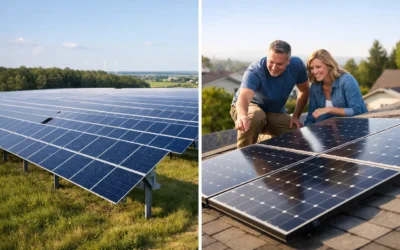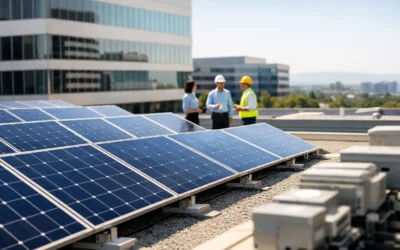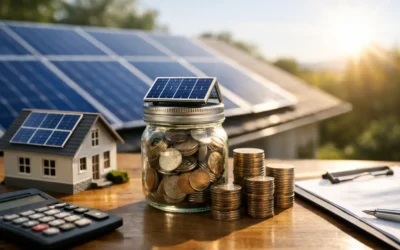
A $150 power bill does not stay $150 forever. Utility rates rise, seasonal peaks hit hard, and for many property owners, the real question is not whether energy costs will increase – it is how much do solar panels save once you install them.
The short answer is that solar can save anywhere from a modest amount each month to tens of thousands of dollars over the life of a system. For some homeowners, that means cutting electric bills by 50% to 90%. For commercial properties, farms, and public facilities with high daytime energy use, the savings can be even more meaningful because solar offsets expensive usage at scale.
Still, there is no honest one-size-fits-all number. Savings depend on your utility rates, system size, local sunlight, roof or ground space, financing terms, and whether your utility offers strong net metering or less favorable export compensation. Solar is often a smart financial move, but the exact payoff depends on the project.
How Much Do Solar Panels Save on Average?
For a typical U.S. homeowner, solar savings often fall between $1,000 and $2,500 per year, though higher-cost electricity markets can push that number above it. Over 25 years, that can add up to $25,000 to $60,000 or more in avoided utility costs, especially if utility prices keep rising.
Commercial and agricultural properties can see much larger totals because they usually consume more electricity. A warehouse, office, school, municipal building, or farm operation may save thousands or even tens of thousands of dollars per year if solar is sized correctly and installed where energy use is substantial during daylight hours.
That said, average savings can be misleading. A home in Arizona with strong sun and expensive power will not perform the same as a shaded property in a lower-rate market. The real value comes from project-specific numbers, not national averages.
What Actually Determines Solar Savings?
The biggest factor is your current electric bill. Solar offsets what you would otherwise buy from the utility, so properties with higher usage and higher rates usually see stronger returns. If your rate is 12 cents per kWh, your savings math looks very different than if you are paying 28 cents.
Sun exposure matters too. More sunlight generally means more production, but orientation, roof pitch, shading from trees, and local weather all affect output. A well-placed system in a sunny market will generate more electricity than a similar-sized system in a cloudy area.
System size also changes the equation. A smaller system may trim your bill nicely without covering all usage. A larger one can offset more energy, but only if your roof, land, budget, and utility rules support it. Oversizing is not always the best move if exported power is compensated at a low rate.
Financing matters as much as production. If you buy a system outright, your long-term savings are usually higher because you avoid loan interest and keep the full financial benefit after payback. If you finance, you may still save from month one, but the amount depends on loan terms. Leases and power purchase agreements can reduce upfront cost, though total lifetime savings are often lower than ownership.
Then there are incentives. The federal solar tax credit can significantly lower installation cost for eligible buyers. State, local, and utility incentives may improve the numbers further, although availability varies widely. Businesses and organizations may also have depreciation or tax-related benefits that strengthen the return.
How Solar Savings Show Up on Your Bill
Most people think of solar savings as one simple before-and-after utility bill comparison. In practice, it is a little more layered.
First, solar lowers the amount of electricity you need to buy from the grid. If your system produces power while your property is using it, you are directly offsetting utility purchases in real time. That is usually the most valuable form of savings.
Second, many utilities credit excess power sent back to the grid. If your system produces more than you use during sunny hours, those credits can help offset evening or low-production periods. Where net metering is strong, savings are often better. Where export rates are lower, your savings may depend more on matching solar production to your daytime usage.
Third, solar can protect against future utility rate increases. Even if your current savings look moderate, avoided cost growth over the next 20 to 25 years can make the investment more attractive than it first appears.
Homeowners: What a Realistic Savings Scenario Looks Like
Consider a homeowner paying around $200 per month for electricity, or $2,400 per year. If a properly sized solar system offsets 75% to 90% of that bill, annual savings could land somewhere between $1,800 and $2,160, before considering future utility increases.
If that homeowner receives the federal tax credit and buys a system with favorable pricing, payback could happen in roughly 7 to 12 years in many markets. After that, the ongoing production is where the long-term value builds.
But there are trade-offs. If the roof is shaded, the home uses very little power, or local utility rates are low, savings may be more modest. Solar still may make sense for energy independence and bill stability, but the financial case will not look identical in every zip code.
Commercial, Agricultural, and Public-Sector Savings
For larger properties, solar savings often become a budget strategy rather than just a bill reduction.
A business with large daytime loads can benefit because solar output lines up well with operating hours. Retail, office, manufacturing, self-storage, and industrial properties may all reduce a significant chunk of utility spending if the system is designed around actual usage patterns.
Agricultural operators often have a strong case too, especially where irrigation, refrigeration, ventilation, or processing drives electricity use. Farms with open land may also have more siting flexibility than a typical homeowner, which can help optimize production.
Government and institutional buyers, including schools and municipal buildings, often look at solar through the lens of long-term operating cost control. Even when procurement and approval processes are more involved, stable energy costs can be valuable for budgeting.
In each case, the right contractor matters. A residential installer may not be the best fit for a farm, school, or commercial facility with more complex energy needs.
What Can Reduce Your Savings?
Solar is not magic, and there are situations where savings are smaller than expected. Poor system design is one of the biggest risks. If the array is undersized, badly oriented, or installed without a clear understanding of your usage profile, you may leave money on the table.
Roof condition can also affect project value. If a roof needs replacement soon, it is often smarter to handle that before installation rather than pay to remove and reinstall panels later.
Utility policy is another variable. Some areas offer excellent net metering, while others credit exported power at a lower rate. That does not automatically make solar a bad idea, but it changes how the system should be sized and evaluated.
Maintenance is usually limited, but it is not zero. Panels are generally low-maintenance, though inverters may need replacement during the system life, and output can be affected by dirt, shade growth, or equipment issues if they are not addressed.
How to Estimate Your Own Solar Savings
Start with 12 months of electric bills. You want your annual usage in kilowatt-hours, your average monthly cost, and any seasonal spikes. This gives contractors a clearer picture of how much energy you use and when you use it.
Next, look at your property basics. Roof age, shading, orientation, usable space, and service panel condition all matter. Ground-mount options may open more possibilities for some rural, agricultural, or commercial sites.
Then compare multiple quotes. This is where many buyers save time and avoid bad assumptions. One contractor may size for maximum production, another may optimize for payback, and another may suggest battery storage based on your rate structure or backup power goals. Seeing more than one proposal helps you judge what is realistic.
If you are still early in the process, using a platform like Solar Contractors can make that comparison easier by helping you connect with professionals who match your project type. A homeowner, business owner, and farm operator do not need the same installer, and your quote process should reflect that.
The Bigger Financial Picture
When people ask how much do solar panels save, they are usually thinking about the utility bill. That is the most visible benefit, but not always the only one.
Solar can improve property appeal, especially in markets where buyers value lower operating costs. It can also reduce exposure to volatile energy pricing and support sustainability goals that matter to businesses, institutions, and many homeowners.
The strongest solar projects are not built on hype. They are built on real usage data, realistic production estimates, and pricing that makes sense for the property. If the numbers work, solar can turn a rising monthly expense into a long-term asset.
The best next step is simple: get your bills, compare quotes, and let actual project numbers answer the question for your property. That is where solar starts to go from interesting idea to smart decision.