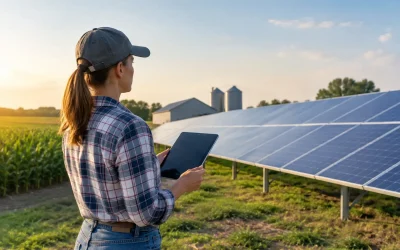
A solar array that looks right on a barn roof can still be the wrong size for the farm. When learning how to size farm solar, start with the electricity your operation actually uses – especially during costly summer irrigation, grain drying, cooling, ventilation, or processing periods. The goal is not to cover every available square foot with panels. It is to build a system that reduces the right energy costs and makes financial sense for your operation.
Start With Your Farm’s Energy Use
Your utility bills are the foundation of solar sizing. Gather at least 12 months of electric bills so you can see annual kilowatt-hour usage, monthly peaks, demand charges, rate changes, and seasonal patterns. One recent bill may not reflect a farm that uses far more electricity during planting, harvest, or hot-weather irrigation.
Look beyond the total annual number. Identify what drives usage and when it happens. A dairy may run ventilation and milk cooling every day. A poultry operation may have steady lighting, heating controls, and fans. An irrigated row-crop farm may consume most of its power in a few high-use months. A grain operation may have a short but intense demand window during drying season.
This distinction matters because solar production also changes by season and time of day. A system sized only from annual consumption can be a good starting point, but it may not deliver the same bill savings for every rate structure or operating schedule.
How to Size Farm Solar From Annual Usage
A simple first estimate begins with annual electricity consumption. In many parts of the United States, one kilowatt of solar capacity produces roughly 1,200 to 1,700 kilowatt-hours per year. The range varies with local sun exposure, panel orientation, shading, equipment efficiency, weather, and system losses.
Use this planning formula:
Solar system size in kW = annual electricity use in kWh ÷ expected annual kWh produced per kW
For example, a farm using 120,000 kWh per year in an area where solar produces about 1,500 kWh per kW would start with this estimate:
120,000 ÷ 1,500 = 80 kW
That does not automatically mean an 80 kW installation is the best project. It gives you a useful baseline for conversations with agricultural solar contractors. The final system may be smaller or larger after reviewing your utility rules, available space, future load, and financial objectives.
A practical target is often to offset a substantial share of annual use without producing more electricity than your utility credits fairly. In some areas, excess generation earns a lower value than the electricity you buy. If that is the case, oversizing can stretch out the payback period.
Consider Demand Charges Separately
Some agricultural and commercial utility accounts include demand charges. These charges are based on the highest amount of power your equipment draws during a set interval, often 15 minutes, rather than the total energy consumed over a month.
Solar can lower energy charges by producing kilowatt-hours, but it may not eliminate a demand peak that occurs after sunset or during cloudy conditions. If your irrigation pump, refrigeration equipment, or grain dryer creates large peaks, ask an installer to model both energy savings and demand-charge savings. Battery storage, equipment scheduling, or demand controls may be part of the better answer.
Match the System to Seasonal Farm Loads
Farms rarely use electricity in a perfectly even pattern. That is why monthly usage data is more valuable than an annual total alone.
An irrigation operation may need the largest solar output from late spring through early fall, which often aligns well with high solar production. Still, a pump that runs mostly at night will not receive the same direct benefit as one that operates in the middle of the day. Changing pump schedules, where agronomically practical, can improve the value of solar power.
Livestock facilities may have more consistent year-round use, but hot-weather ventilation can create a major summer spike. Cold storage and agricultural processing can also have load profiles that pair well with daytime solar generation. For farms planning new buildings, electrified equipment, additional wells, or expanded production, include those expected loads before finalizing the array size.
It is usually less expensive to design for a foreseeable expansion now than to rework interconnection equipment or site infrastructure later. But do not guess at growth. Base the projection on real plans, equipment specifications, and reasonable operating assumptions.
Choose the Right Location and Available Space
Farm solar can go on rooftops, carports, unused land, or purpose-built ground mounts. Each option affects the system size, installation cost, and long-term maintenance plan.
A south-facing roof with limited shade can be a strong option, especially when it is structurally sound and has many years of useful life left. Before placing panels on an older barn or equipment building, assess roof condition and structural capacity. Replacing a roof after installing solar adds avoidable cost and disruption.
Ground-mounted solar gives more flexibility for orientation and tilt, and it can make cleaning and maintenance easier. However, the site needs room for setbacks, access paths, drainage, electrical equipment, and panel-row spacing to prevent self-shading. Avoid highly productive acreage when a marginal parcel, buffer area, or underused land can serve the project instead.
Shade deserves close attention. Trees, silos, grain legs, nearby buildings, and even future construction can reduce output. A professional site assessment should account for year-round shading, not just what the site looks like at noon on a clear day.
Check Utility Rules Before You Commit
Utility interconnection requirements can shape the practical size of a farm solar project. Your utility may limit system capacity based on historical usage, transformer capacity, feeder conditions, or the size of your electrical service. It may also have different compensation rules for exported power.
Ask early about net metering, net billing, avoided-cost credits, time-of-use rates, demand charges, and any required upgrades. These details can change the economics of a system dramatically. A farm with favorable crediting for excess generation may support a different design than one where exported electricity receives a modest payment.
The interconnection process can also take time. Larger systems may require engineering review, studies, or utility upgrades. Planning around crop cycles, construction access, and equipment delivery helps avoid putting an installation in the middle of your busiest season.
Factor in Incentives and Project Economics
The best solar size is not always the one with the shortest equipment quote. Evaluate expected production, utility savings, financing costs, incentives, maintenance, and the value of your remaining utility bill.
Federal tax incentives may reduce the net cost of eligible solar projects, and some farms may qualify for additional incentives based on project location or other criteria. State programs, utility rebates, and agricultural financing options can also affect the numbers. Incentive eligibility and tax treatment depend on your business structure and project details, so confirm them with qualified tax and solar professionals.
A good proposal should show estimated annual production in kWh, projected bill savings, assumptions about utility rates, system degradation over time, warranty coverage, and the expected payback period. Be cautious with proposals that promise a specific savings figure without showing the assumptions behind it.
Decide Whether Battery Storage Fits
Battery storage is not required for every farm solar project. If your main goal is lowering annual utility costs under a favorable net-metering arrangement, solar alone may be the most cost-effective choice.
Storage becomes more compelling when your farm faces frequent outages, expensive demand charges, weak export compensation, or critical loads that must stay powered. It can support selected equipment during an outage, but backup design must be deliberate. Running an entire dairy, large irrigation system, or grain dryer through a long outage requires much more battery capacity than keeping communications, controls, lighting, and limited refrigeration online.
Get Comparable Quotes From Agricultural Solar Specialists
The fastest way to move from an estimate to a buildable plan is to request proposals based on the same information: 12 months of utility bills, your service address, photos or site plans, available roof or land area, major equipment loads, and any expansion plans.
Compare system capacity, projected production, equipment quality, installation scope, warranties, interconnection support, and financial assumptions – not price alone. A lower-priced bid may exclude structural work, electrical upgrades, monitoring, or utility application support. A larger system may look attractive on paper but produce lower-value excess power.
Find A Contractor through Solar Contractors to compare qualified professionals who understand agricultural energy needs. The right installer will explain the trade-offs clearly, model your actual utility rate, and help you choose a system sized for the way your farm works – not a one-size-fits-all number.