

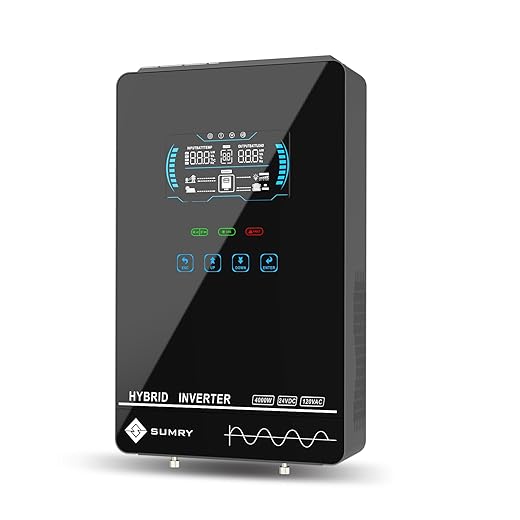


The SUMRY Hybrid Solar Inverter is a 4000W hybrid inverter designed for 24V battery systems, off-grid power setups, backup energy systems, and solar users who want strong charging performance in one compact unit. With a built-in 140A MPPT charge controller, up to 5,600W of solar input, and a maximum PV input voltage of 350V DC, this inverter offers a lot of capability for the price.
If you are building a solar power system for a cabin, RV, workshop, small home backup system, or off-grid setup, the SUMRY Hybrid Solar Inverter gives you inverter output, solar charging, battery charging, and utility backup control in one device.
What Is the SUMRY Hybrid Solar Inverter?
The SUMRY Hybrid Solar Inverter is a 4000W inverter with a 24V DC battery input and 120V AC output. It converts stored battery power or incoming solar power into usable AC power for appliances, tools, lights, electronics, and other compatible loads.
Unlike a basic inverter, the SUMRY Hybrid Solar Inverter includes a built-in MPPT solar charge controller. This allows solar panels to connect directly to the inverter so the system can harvest solar energy, charge batteries, and power AC loads from one centralized unit.
SUMRY Hybrid Solar Inverter Specifications
- Product: SUMRY Hybrid Solar Inverter
- Model: HGX-4KW
- Rated output power: 4000W
- Peak output power: 8000W
- Battery input: 24V DC
- AC output: 120V AC
- MPPT charge current: 140A
- Maximum PV input power: Up to 5,600W
- Maximum PV input voltage: Up to 350V DC
- MPPT efficiency: Approximately 98%
- Battery compatibility: AGM, Gel, Lead-acid, Li-ion, and LiFePO4
Why the 140A MPPT Controller Matters
One of the strongest features of the SUMRY Hybrid Solar Inverter is its built-in 140A MPPT charge controller. MPPT stands for Maximum Power Point Tracking. This technology helps the inverter pull the best available power from your solar panels based on sunlight conditions, panel voltage, battery condition, and system demand.
A 140A charge controller is powerful for a 24V system. At 24V, 140 amps equals about 3,360 watts of theoretical charging power going into the battery bank.
How Much Solar Can the SUMRY Hybrid Solar Inverter Handle?
The SUMRY Hybrid Solar Inverter can accept up to 5,600W of solar panel input and up to 350V DC PV input voltage. This gives the inverter strong solar headroom for a 24V hybrid system.
Even though the inverter can accept up to 5,600W of solar input, battery charging output is still limited by the 140A charge rating. The extra solar capacity can be useful when the inverter is powering AC loads and charging batteries at the same time.
Real-World Charging Performance
The SUMRY Hybrid Solar Inverter can deliver fast battery charging when paired with the right battery bank. For example, a 24V 200Ah battery bank stores about 4,800 watt-hours of energy. In theory, charging at the full 3,360W rate could recharge that battery in about 1.4 hours.
In real-world use, charging usually takes longer. Batteries do not charge at maximum current from empty to full. Most battery charging includes bulk, absorption, and float stages. As the battery gets closer to full, charge current often tapers down.
Battery Compatibility
The SUMRY Hybrid Solar Inverter supports AGM, Gel, Lead-acid, Lithium-Ion, and LiFePO4 batteries. This flexibility makes it useful for different solar setups.
For best performance, the inverter settings should match the battery type you are using. Selecting the correct battery profile helps the inverter use the proper charging voltage, charging current, and charging behavior.
Can the SUMRY Hybrid Solar Inverter Run Without Batteries?
The SUMRY Hybrid Solar Inverter may support battery-less daytime operation when enough solar input is available. This can allow the inverter to power loads directly from solar panels during the day.
However, battery-less operation has limitations. Solar production changes throughout the day. Without a battery acting as a buffer, the inverter may rely more on utility power or may not operate as smoothly under changing solar conditions.
Advantages of the SUMRY Hybrid Solar Inverter
Strong 140A MPPT Charging
The biggest advantage of the SUMRY Hybrid Solar Inverter is the 140A MPPT charge controller. This high charge rating allows faster battery recharging when the battery bank and solar array are properly sized.
High Solar Input Capacity
With support for up to 5,600W of PV input, the inverter can handle a substantial solar array for a 24V system.
High PV Voltage Limit
The 350V DC maximum PV input allows higher-voltage solar strings. This can help reduce current on the solar wiring side and may make longer panel-to-inverter wire runs more practical when properly designed.
Flexible Power Priority Settings
The SUMRY Hybrid Solar Inverter allows users to configure solar, battery, and utility priority. This is helpful for people who want to prioritize solar power, preserve battery capacity, or use utility power as a backup.
Limitations of the SUMRY Hybrid Solar Inverter
24V System Only
This model is designed for a 24V battery system. If you are planning a 12V system or a 48V system, this specific inverter may not be the correct fit.
High DC Current Requires Proper Wiring
A 140A charge current is substantial. Battery cables, fuses, breakers, disconnects, and bus bars must be sized correctly.
Battery-Less Operation Has Limits
Although battery-less operation can be useful during the day, it may not be ideal for every setup. If solar input drops, the inverter may need to pull from the grid or shut down depending on system conditions.
Installation Tips for the SUMRY Hybrid Solar Inverter
- Use the correct battery charging profile.
- Size battery cables for high-current 24V operation.
- Install properly rated fuses, breakers, and disconnects.
- Do not exceed the maximum PV input voltage or wattage.
- Provide good ventilation around the inverter.
- Monitor the LCD after startup to confirm correct operation.
Who Should Buy the SUMRY Hybrid Solar Inverter?
The SUMRY Hybrid Solar Inverter is a good option for users who want a powerful 24V hybrid inverter with strong solar charging capability. It is especially useful for people who want one device that can manage solar input, battery charging, AC output, and utility backup.
- Off-grid cabin owners
- Workshop or shed solar systems
- Backup power setups
- Small home energy systems
- Solar users with 24V battery banks
- People using LiFePO4 batteries
Final Verdict on the SUMRY Hybrid Solar Inverter
The SUMRY Hybrid Solar Inverter is a capable 4000W hybrid inverter for 24V solar systems. Its built-in 140A MPPT charge controller is the standout feature, allowing strong charging performance and support for a large solar array.
For off-grid users, backup power setups, workshops, cabins, and medium-size solar projects, the SUMRY Hybrid Solar Inverter offers a useful mix of power, flexibility, and affordability.
Frequently Asked Questions About the SUMRY Hybrid Solar Inverter
Is the SUMRY Hybrid Solar Inverter good for off-grid systems?
What battery voltage does the SUMRY Hybrid Solar Inverter use?
How much solar can the SUMRY Hybrid Solar Inverter handle?
What batteries work with the SUMRY Hybrid Solar Inverter?
Can the SUMRY Hybrid Solar Inverter run without batteries?
Is the SUMRY Hybrid Solar Inverter worth buying?
Where To Buy the 4000W SUMRY Hybrid Solar Inverter

Solar Panel Monitoring Software Review
Solar panel monitoring software review for homeowners, businesses, farms, and public buyers comparing features, alerts, reporting, and value.

Solar Panel Quote Tool Review: Is It Worth It?
Our solar panel quote tool review explains how quote tools work, what they miss, and how to use them to compare installers with more confidence.
AeternaSol 400W (200W×2) Type-N Mono Solar Panel Review
AeternaSol 400W solar panel review covering efficiency, N-type cell technology, durability, installation considerations, and real-world off-grid performance.